EMI Shielding for Plastic Enclosures: Vacuum Metalizing vs. Conductive Paint
When a plastic enclosure requires EMI shielding, plastic enclosure, vacuum metalizing is the process that provides effective shielding with very little material. Vacuum metalizing deposits metal, most commonly aluminum, at a coating thickness of 0.5–25 microns, with no measurable impact on dimensional tolerances or part fit — while typically delivering more than 60 dB of attenuation. Conductive spray coatings use nickel-, copper-, silver-, or other conductive filler systems to provide EMI/RFI shielding, with shielding effectiveness commonly ranging from 40–80 dB depending on the coating formulation, film thickness, frequency, and application, and remain the right solution for certain geometries. Both processes add a conductive shielding layer to a nonconductive plastic housing. This guide compares their performance, advantages, and application considerations to help determine which process is better suited to your part.
Why Plastic Enclosures Need EMI Shielding
Plastics are effectively transparent to electromagnetic energy. An unshielded plastic housing lets emissions from clocks, switching supplies, and high-speed buses radiate out — and lets external interference in. When a product fails emissions testing or suffers susceptibility problems in the field, adding a conductive layer to the inside of the existing enclosure is usually far cheaper than redesigning the housing in metal. That is the core service behind Mueller's EMI/RFI/ESD shielding offering.
Regardless of which process is used, effective EMI/RFI shielding depends on more than the coating itself. The conductive coating must provide appropriate coverage and work with the enclosure's grounding, seams, and openings. These design factors can affect overall shielding performance, so the coating process should be evaluated as part of the complete enclosure design.
The Primary Option: Vacuum Metallization
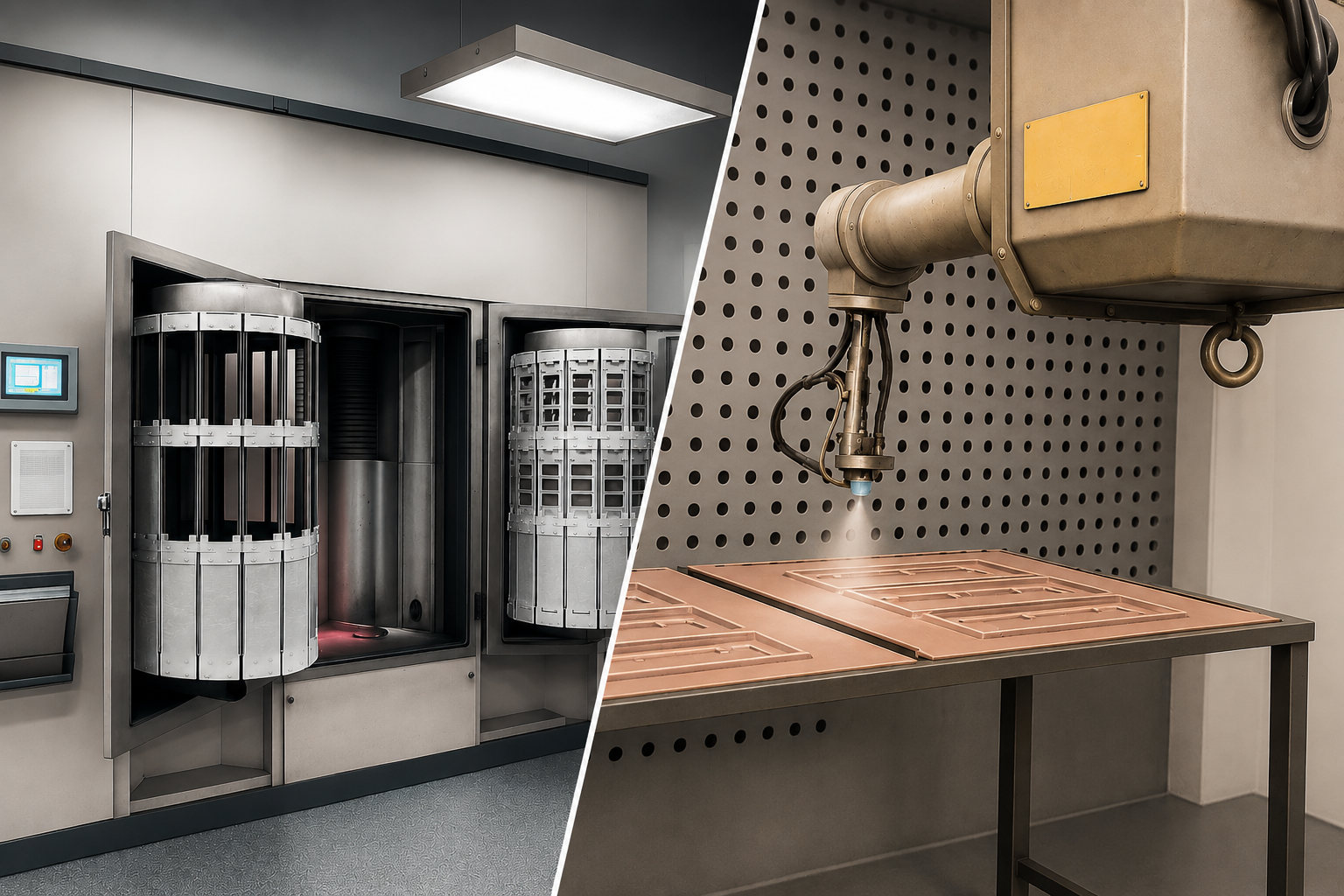
Vacuum metalizing deposits aluminum onto the enclosure inside a vacuum chamber through thermal evaporation, producing an extremely thin, uniform, highly conductive film that typically delivers 60 dB of attenuation. At 0.5–25 microns it adds essentially no weight and no dimensional change, which protects snap fits, bosses, gasket lands, and tight tolerances that a thicker coating would compromise. It is a batch process that becomes more cost-efficient at higher production volumes and produces a uniform conductive metal layer rather than a coating made with metal particles suspended in resin.
Mueller has provided vacuum metalizing services since 1955 and accommodates parts up to 24 inches by 60 inches, depending on part geometry, with fixtures designed and built in-house. Learn more about the process on our vacuum metalizing technology page and explore our functional vacuum metalizing capabilities.
The Complement: Conductive Spray Coatings
Conductive spray coatings are applied like paint: a carrier resin loaded with conductive metal particles — nickel, copper, silver, or other conductive filler chosen to balance conductivity against the attenuation requirement. Conductive coatings are sprayed onto interior surfaces at a typical thickness of 1–2 mils (25–50 microns; up to 10 mils), providing 40–80 dB of attenuation depending on the coating formulation. Because coverage follows the gun rather than line-of-sight from a fixed source, spray reaches ribs, bosses, and deep interior pockets that would shadow in a chamber, and it can be applied selectively to only the zones that need shielding. It also has no chamber size limit, which makes it the practical choice for enclosures larger than the vacuum chamber envelope. See Mueller's functional spray coatings for the broader family of engineered spray finishes.
Vacuum Metalizing vs. Conductive Paint: Side by Side
| Attribute | Vacuum metalizing | Conductive spray coating |
|---|---|---|
| Typical coating thickness | 0.5–25 microns with no measurable impact on dimensional tolerances or part fit | Typically, 1–2 mils (25–50 microns; up to 10 mils). Depending on coating formulation |
| Typical attenuation | >60 dB | 40–80 dB (depending on coating formulation) |
| Conductive metal | Aluminum or multi-layer metal systems, including copper/aluminum, copper/stainless steel, and copper/nickel chrome | Nickel-, copper-, Silver-, or silver coated copper-based formulations |
| Weight impact |
Lightweight alternative to metal enclosures |
Adds minimal weight while providing conductive shielding |
| Surface Uniformity | Excellent coating, uniformity and repeatability | Good to high coating uniformity |
| Part size | Up to 24 in. diameter × 60 in. long | No chamber limit |
| Coverage of complex geometries | Line-of-sight process; coverage is limited by chamber size and part geometry | Well suited for complex geometries, irregular parts, and large formats |
| Selective application | Achieved through custom masking and tooling fixtures | Achieved through masking and selective spray application |
| Best fit | High-volume OEM plastic enclosures where appearance, consistency, and repeatability are critical | Large, irregular, or complex parts requiring flexible production and maximum design freedom |
How to Choose
Start from the attenuation target and frequency range in your EMC plan, then let the part decide. For most production plastic enclosures — open interior surfaces, tight tolerances, meaningful volume — vacuum metalizing is the default worth specifying first: it delivers the performance with the least material and the least risk to fit. Move to conductive spray when the part argues for it, and it often will: an enclosure with deep internal pockets, a housing larger than the chamber envelope, or a design that needs only a few discrete shielding zones.
Substrate matters too. Mueller works with a wide range of substrates, including ABS, ABS/PC, polycarbonate, nylon (PA), polystyrene, SAN, PET, PP, HDPE, and 3D-printed components. Substrate compatibility and any required surface preparation depend on the material, coating system, and application requirements, so Mueller can evaluate a sample and identify compatibility considerations before quoting. Because Mueller offers both vacuum metalizing and conductive spray coating capabilities under one roof, our team can evaluate your actual part, shielding requirements, geometry, and production needs to recommend the appropriate process.
Frequently Asked Questions
Does shielding change my enclosure's dimensions?
Vacuum-deposited metallic coatings can be applied at 0.5–25 microns with no measurable impact on dimensional tolerances or part fit. Conductive EMI/RFI spray coatings typically run 1–2 mils (25–50 microns; up to 10 mils), depending on the coating formulation and application requirements. Flag any critical fits so they can be masked or accounted for.
Which option provides more attenuation?
Vacuum-metallization provides typical attenuation of more than 60 dB; while conductive spray coatings provide 40–80 dB depending on the coating formulation. The right process depends on the shielding requirements as well as part geometry, size, production volume, and other application requirements.
Can both processes be masked?
Yes. Metalizing is masked through fixtures Mueller builds in-house; spray coatings are masked or simply applied selectively. Gasket grooves, antenna windows, and cosmetic surfaces can be kept clean with either process.
Work with Mueller Coatings
Mueller Coatings has been vacuum metalizing since 1955 and finishes more than 50 million parts a year from its East Bridgewater, Massachusetts facility, with both vacuum metalizing and conductive spray coating capabilities.
Not sure which shielding process is right for your part? Talk to Mueller about your application, or request an EMI/RFI shielding quote. Our team can review your part, shielding requirements, geometry, and production needs and will provide process recommendations along with cost.